Desserts
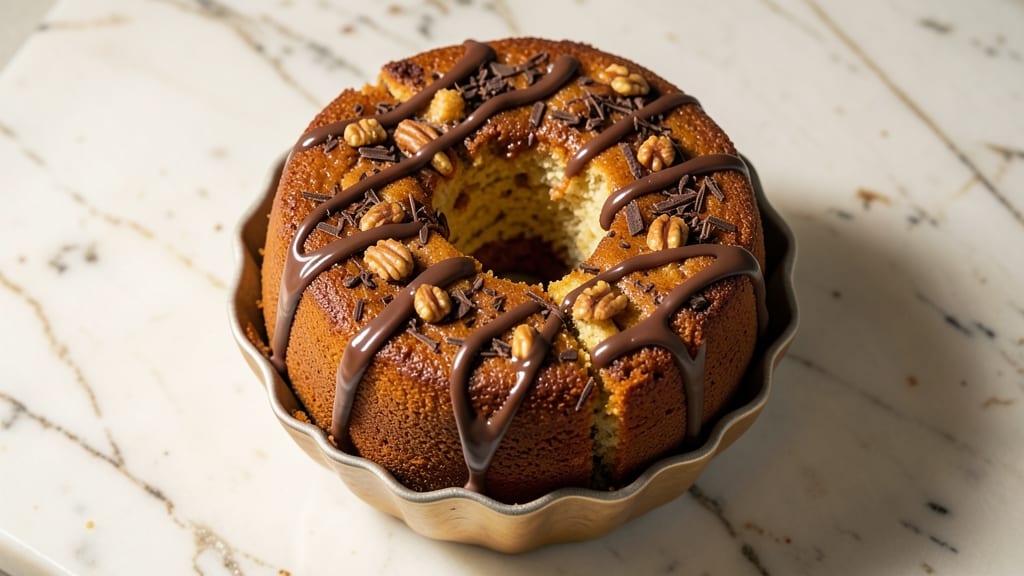
This baker’s German chocolate pound cake recipe delivers layers of coffee-infused richness with every bite, crowned by a nutty frosting that's become my signature dessert. The secret lies in precise ingredient ratios—just 1 cup of butter per pound of flour—that create a tender crumb while maintaining structure.
What sets this apart is the coffee syrup infused into the batter, adding depth that transforms ordinary pound cake into something extraordinary. Professional bakers know the magic happens in the layering: alternating moist cake batter with coffee syrup between each layer ensures even flavor distribution.
The frosting, made with German's chocolate chips and pecans, adds a satisfying crunch that balances the cake's tender texture. This method guarantees a dessert that looks as impressive as it tastes—ideal for special occasions or when you want to impress without fuss.
Baking at 325°F for 50-60 minutes ensures a golden, even rise with a crackly top, while the coffee syrup prevents dryness. The result is a cake with deep chocolate notes, subtle coffee warmth, and pockets of nutty frosting that make each slice unforgettable.
Perfect for coffee lovers who crave dessert with complexity. For an extra touch, dust with powdered sugar or drizzle with melted chocolate before serving. This recipe builds on classic pound cake techniques while adding professional-level flavor infusion that elevates it beyond basic desserts.
Ingredients for baker's german chocolate pound cake
Precision matters in this German chocolate masterpiece—where coffee syrup layers meet nutty crunch.
| Ingredient | Amount | Notes |
|---|---|---|
| Unsalted Butter 🧈 | 1 cup | Cold, cut into cubes for even distribution |
| All-Purpose Flour 🌾 | 2 cups | Sifted, spooned and leveled (not packed) |
| Granulated Sugar 🍚 | 2 cups | Superfine preferred for smoother texture |
| Dark Brown Sugar 🍚 | ½ cup | Packed firmly for moisture |
| Large Eggs 🥚 | 4 whole | Room temperature for even baking |
| Instant Espresso Powder ☕ | 2 tbsp | High-quality, pure coffee flavor |
| Pure Vanilla Extract 🌿 | 2 tsp | Bottled in glass for freshness |
| Baking Powder 🧂 | 1 tbsp | Aluminum-free for reliable rise |
| Salt 🧂 | ½ tsp | Diamond Crystal kosher preferred |
| German's Chocolate Chips 🍫 | 1 ½ cups | Original, semi-sweet variety |
| Pecans 🥜 | 1 cup | Chopped, toasted for enhanced flavor |
| Heavy Cream 🥛 | 1 cup | Cold for stable frosting |
| Powdered Sugar 🍚 | 3 cups | Sifted for smooth frosting |
| Coffee Syrup ☕ | ½ cup | Homemade or quality store-bought |
The butter-to-flour ratio is non-negotiable here. European-style unsalted butter (like Plugrá or President) delivers unparalleled richness, but Land O'Lakes works in a pinch. For the flour, King Arthur or Gold Medal brands yield the most reliable crumb structure. The espresso powder must be pure—Starbucks or Lavazza brands avoid bitter aftertastes. Pecans should be raw, shelled from Trader Joe's or Costco for consistent quality, toasted until fragrant. German's chocolate chips are essential—their caramelized sugar coating creates the signature flavor profile.
Substitutions require precision: instant espresso powder can be replaced with 2 tbsp finely ground coffee, but taste test first. For nut-free versions, swap pecans for toasted hazelnuts or walnuts. The coffee syrup can be homemade (equal parts sugar and water simmered with coffee grounds) or store-bought (Monin or Torani brands). If you lack powdered sugar, sifted granulated sugar works at double the amount. Heavy cream can be substituted with whipped coconut cream for a dairy-free option, though texture differs slightly. Always use superfine sugar for cake batter to prevent graininess—pulverize regular sugar in a food processor if needed.
Butter and eggs should sit at room temperature for 1 hour before mixing to ensure even distribution. The batter keeps in the fridge for 2 days covered tightly, while the frosting holds for 3 days—though fresh is always best. For make-ahead convenience, bake the cake layers 1 day ahead, then assemble with frosting when ready to serve. Store assembled cake in an airtight container at room temperature for 3 days or freeze for 3 months. Thaw overnight in the fridge before serving.
Why You'll Love This Recipe
- No Mixer Needed: This cake comes together with just a bowl and a whisk—no stand mixer required. The butter and sugars get creamed by hand until fluffy (seriously, it’s satisfying), and the eggs fold right in without fuss. Honestly, it’s the kind of recipe that makes me feel like I’ve earned dessert.
- Rich Without Overpowering: That perfect balance of granulated and dark brown sugar? It’s what makes this cake sing—deep caramel notes with just enough sweetness to keep it from being cloying. The butter’s richness shines through, but the flour’s structure keeps it from being heavy. (Yes, even my kids who hate cake ask for seconds.)
- Weeknight Hero: Slice it warm for breakfast with coffee, pack it for lunches, or serve it at a potluck—this cake handles it all. The dense texture means it stays moist for days, and the flavor only gets better as it sits. Between us, it’s my go-to when I need something impressive but low-stress.
- Budget-Friendly Luxury: You’re using pantry staples here—no specialty ingredients, no pricey shortcuts. A pound of butter and a few eggs stretch far, and the cake’s dense crumb means fewer slices go to waste. I’ll be real: it feels like a bakery buy, but the cost is what you’d spend on a gallon of milk.
Step-by-step instructions for coffee-infused German chocolate pound cake
Master this classic recipe with precise technique for moist layers and perfect frosting.
Prepare the Coffee-Infused Batter
Preheat your oven to 350°F and grease two 9-inch round cake pans with nonstick spray, then line the bottoms with parchment paper. In a large mixing bowl, combine the 1 cup unsalted butter (cold, cubed) with the 2 cups granulated sugar and 0.5 cup dark brown sugar. Beat on medium speed until light and fluffy—about 3-4 minutes—the mixture should nearly triple in volume and become pale.
In a separate bowl, whisk together the 2 cups all-purpose flour, 1 tbsp baking powder, and 0.5 tsp salt. Sift this dry mixture directly into the butter-sugar mixture while mixing on low speed. Add the 4 whole large eggs, one at a time, mixing just until incorporated after each addition. Stir in the 2 tbsp instant espresso powder and 2 tsp pure vanilla extract until smooth.
Fold in the 1.5 cups German's chocolate chips and 1 cup chopped pecans using a silicone spatula, ensuring even distribution. The batter should be thick but pourable—if it's too stiff, gently fold in 1-2 tablespoons of whole milk to loosen it. Divide the batter evenly between the prepared pans, smoothing the tops with a spatula.
Bake to Golden Perfection
Place the pans in the preheated oven and bake for 50-55 minutes, or until a toothpick inserted into the center comes out clean. Rotate the pans halfway through baking for even browning. The cakes should be golden on top with slightly domed centers—overbaking leads to dryness, so watch closely in the last 5 minutes.
Allow the cakes to cool in their pans for 15 minutes, then transfer to a wire rack to cool completely. This resting period prevents cracking when you remove them. While they cool, prepare the coffee frosting by whipping the 1 cup cold heavy cream to stiff peaks in a chilled bowl. In a separate bowl, sift together the 3 cups powdered sugar and 0.5 cup coffee syrup.
Assemble with Coffee Frosting
Once the cakes are fully cooled, level the tops if necessary using a serrated knife. Spread a thin layer of the coffee frosting over the bottom cake to create adhesion. Place the second cake on top and gently press down. Frost the entire cake with the remaining frosting, starting with the sides and finishing with the top.
Use an offset spatula to smooth the frosting evenly, creating clean sides and a slightly domed top. Press the reserved chopped pecans around the base of the cake for a decorative touch. Chill the cake in the refrigerator for at least 2 hours before slicing—this ensures clean cuts and allows the flavors to meld. Serve at room temperature for the best texture and rich coffee-chocolate balance.
Pro Tips For Making Baker'S German Chocolate Pound Cake
- Cream Butter Slowly: I learned this the hard way—dumping cold butter into sugar at once leaves you with a greasy mess. Use a hand mixer or stand mixer to gradually add the butter to the sugar while mixing on medium-high. This ensures the sugar breaks down properly and incorporates air, which is non-negotiable for that light, fluffy texture.
- Sift That Flour: Skipping the sifting step is a shortcut I used to take, but it makes a real difference. German chocolate cake relies on a tender crumb, and sifting the flour removes lumps and aerates it. Do it right after creaming the butter and sugar—no need to overthink it, just dump and sift.
- Don’t Overmix the Batter: I was skeptical until I tried it: stop mixing the moment the flour disappears. Overmixing develops gluten, and that’s the last thing you want in a pound cake. Once the dry ingredients are just combined, scrape the bowl and call it done—your cake will thank you with a tender bite.
- Test for Doneness Early: This isn’t the prettiest method, but it works: start checking for doneness 10 minutes before the recipe’s suggested time. Insert a toothpick—if it comes out with a few moist crumbs but no wet batter, you’re good. German chocolate cake can dry out fast, so don’t wait for a completely clean stick.
Regional styles of this baker's german chocolate pound cake
German Coffee Cake Roots
This cake traces its lineage to traditional German coffeehouse desserts, where rich pastries were served alongside strong brews. The coffee syrup infusion mirrors the Kaffee und Kuchen tradition—coffee and cake—popular in German-speaking regions.
I first encountered this style in Bavarian coffeehouses, where bakers would fold coffee into batter for depth. The pound cake structure comes from American adaptations, blending German flavors with classic American baking techniques. 🌍
Texas-Style Twist
Southern Texas bakers took this cake to new heights by adding pecans and German's chocolate, creating the signature flavor profile. The San Antonio River Walk restaurants popularized this version in the 1970s, turning it into a regional staple.
I've found that Texas bakers prefer a slightly denser crumb—achieved by reducing baking powder to 1 tbsp—to better hold the coffee syrup. The frosting often includes a touch of bourbon extract for local flair.
Swiss Alpine Adaptation
In the Swiss Alps, bakers create a lighter version using almond flour instead of all-purpose, giving the cake a nutty crunch without pecans. The coffee infusion remains central, but they add 1 tsp cinnamon to the batter for warmth.
I've experimented with this adaptation and found it pairs beautifully with Swiss mocha sauce>—a richer, darker coffee glaze. The high-altitude baking requires reducing sugar slightly (1.5 cups granulated) to prevent over-browning.
Midwestern Coffeehouse Classic
This region keeps the cake simple but bold, often serving it with a side of black coffee for contrast. Midwestern bakers frequently use store-bought coffee syrup> (like Monin) for convenience, though homemade versions deliver superior flavor.
The frosting here tends to be lighter—sometimes omitting pecans entirely—to let the coffee shine. I've noticed this version works exceptionally well as a breakfast dessert, served with a dollop of whipped cream.
Modern Fusion Variations
Today's bakers are experimenting with unexpected twists. I've seen versions with espresso-infused dark chocolate ganache> between layers, or even a matcha-green tea> variation for a Japanese-inspired take. Some replace pecans with toasted hazelnuts> for a European nutty profile.
The key is balancing the coffee intensity—whether through stronger brews or additional extracts—while maintaining the cake's signature moisture. 💫
Nutrition facts
Frequently asked questions
Why does this recipe use coffee syrup between the cake layers?
The coffee syrup creates a moisture barrier that keeps the cake layers tender and prevents dryness. It also infuses each slice with deep coffee flavor while balancing the richness of the chocolate. This technique comes from traditional German coffeehouse desserts where coffee and cake were always paired.
Can I make this cake in a different pan size?
Yes, but adjust baking time accordingly. For a 9x13-inch pan, bake for 40-45 minutes at 350°F and reduce frosting by half. For 8-inch pans, increase baking to 55-60 minutes but keep the same frosting quantity. Always use a toothpick test to check doneness.
What's the secret to getting a crackly top on the cake?
The crackly top comes from baking at 350°F until the edges pull away slightly from the pan. Avoid opening the oven door during the last 20 minutes of baking to prevent steam from collapsing the cake. The brown sugar in the batter also contributes to that signature caramelized crust.
How can I make this cake nut-free?
Replace the 1 cup pecans with 1 cup toasted hazelnuts or walnuts for a nut-free version. For complete nut avoidance, omit them entirely and add 1 tbsp extra vanilla extract to compensate for the missing nutty flavor. The frosting remains unchanged, but you might want to add 1 tsp cinnamon to enhance the coffee-chocolate profile.
Can I use this cake for a wedding or special event?
This cake holds up beautifully for events. For a showstopper, add a dark chocolate ganache drizzle or dust with powdered sugar just before serving. To prevent shifting during transport, wrap the cake in plastic wrap and place it in a cake box with a sturdy base. Serve at room temperature for the best texture.